2016-01-11: Focus on Non-Destructive Inspection Technologies
University of the District of Columbia (January 11, 2016): A group of approximately 30 people, both young and old, gathered at UDC for the ASCE-NCS Transportation Committee meeting this evening. A civil engineering student was overheard asking, “How much load should a bridge be designed to carry?” The answer he received from an engineering practitioner helped guide his thoughts away from the “should” he struggled with, to the identification of relevant design loads through planning activities. The intermingling of students, practitioners and educators while dining over pizza indeed delivered several insights of value to attendees.
Larry Olson of Olson Engineering, widely known for his expertise in nondestructive evaluation (NDE) and performance monitoring of civil infrastructure including dams, bridges, buildings, foundations, pavements, and tunnels presented the topic “Assessing Concrete Decks: GPR & Impact Echo Scanning”. His skill and experience as a trainer was evident. He kept the audience engaged by pausing to ask questions when he saw attention wavering and adjusted his content delivery. His key message was that a deck evaluation method that is both comprehensive and economical is the use of non-destructive evaluation techniques that can look well below the surface. He showcased Ground Penetrating Radar (GPR) and similar NDE techniques, such as Impact Echo Scanning. He noted that when armed with the results of such evaluations, engineers can develop appropriate mitigation strategies more confidently and cost effectively.
The next presentation by the Transportation Committee of ASCE-NCS will be held on March 8th, 2016. The speaker Hugh Weaver, PE is an expert on aviation pavement with over 30 years of experience at airports across the country will be presenting on “Recent Innovations in Airport Pavement Design”. Please look forward to details on the ASCE-NCS website. http://www.asce-ncs.org/index.php/committees/transportation.
2015-11-10: Impact on Traffic Mobility of V2V Communication
George Washington University (November 10, 2015): How will vehicle-to-vehicle communication impact your commute? Our speaker, Dr. Samer Hamdar, an assistant professor at the George Washington University (GWU) and the Director of the Center of Intelligent Systems Research (CISR – www.cisr.gwu.edu), provided a research-based perspective to this question.
With billions of vehicle miles traveled annually in the U.S alone, significant improvements associated with traffic mobility and safety are needed. Such improvements are represented by an increase in traffic stability and a reduction in congestion. Interactions between individual drivers and errors in the driving decision making processes have been previously identified as major contributors to unsafe and unstable traffic conditions. Two main avenues that reduce/remove human error from the driving experience are being pursued.
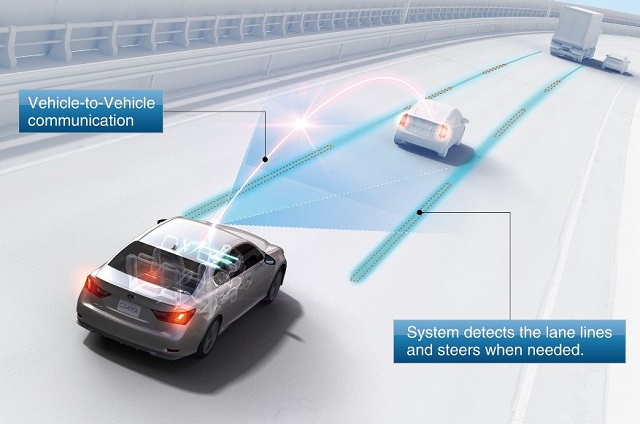
Autonomous vehicles use sensing technology to take on the burden of driving, while connected vehicles incorporate vehicle-to-vehicle and vehicle-to-infrastructure communication to obtain and share information that can allow the driver/vehicle to make better driving decisions.
After presenting existing applications of connected vehicle (CV) technologies as foreseen by the Federal Highway Administration, shared the findings of his research that models the traffic stability of different market penetration rates (MPRs) of connected and autonomous vehicles with focus on car-following and lane-changing maneuvers. The results show an increase in roadway capacity and an improvement in traffic stability as the MPR and the CV level of control increase. However, the greatest benefit comes when all vehicles on the road are autonomous with no human drivers!
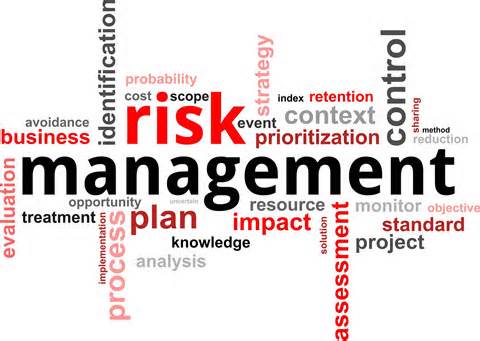
2015-09-08: Risk Informed Civil Project Delivery
George Washington University (September 8, 2015): More often than not, civil infrastructure mega-projects come in over budget while the scope increases as the project moves forward. Why is that? And what can we do about it?
Michael O’Connor shared his insights that he learned in the trenches as a risk manager and direct report to first the director of Federal Transit Administration’s Office of Engineering in its Office of Program Management and then the Regional Administrator in Region II (New York City). His responsibilities included program development for technical requirements in cost and schedule modeling and contingencies; validating megaproject cost and schedules for projects with total value over $25 billion. He provided major inputs into FTA’s proposed rulemaking on risk management including concepts of management capacity and organizational capacity, risk definitions and risk mitigation classification and sequence.
2015-07-18: Railroad Picnic and Excursion
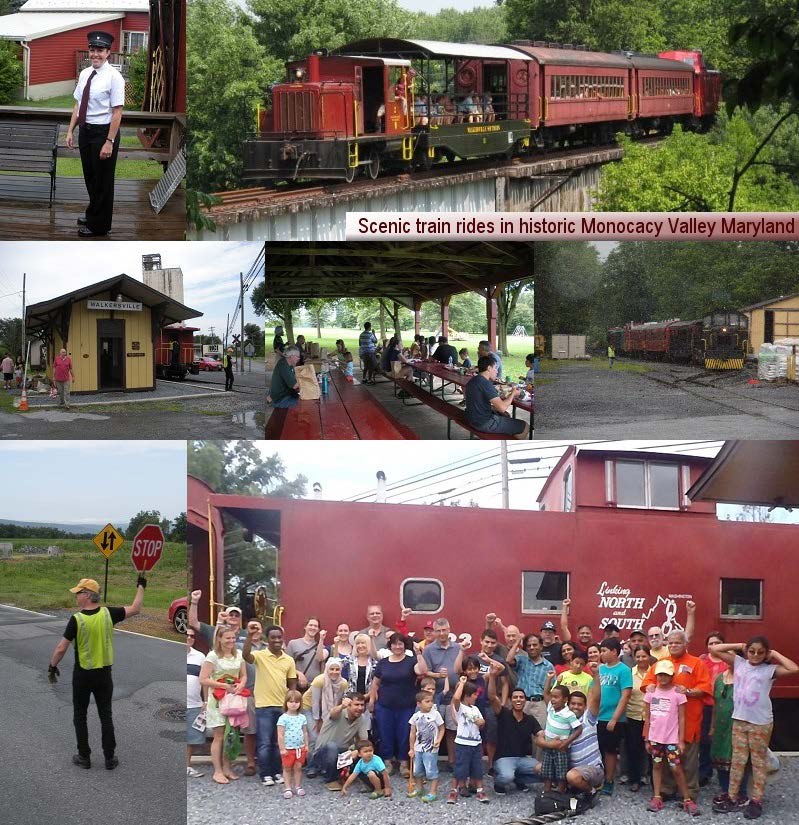
The Transportation Committee hosted its Railroad Excursion & Picnic event on Saturday, July 18, 2015, at the Walkersville Southern Railroad in Walkersville, MD. Despite the morning rain, sometimes heavy, we had a great turnout. L.J. Sauter took the photographs in the collage you see here; Ranjit Sahai took the group photo (bottom right), and the “Scenic train rides…” photo (top right) is courtesy of the Walkersville Southern Railroad.
Photographs, from the top to the bottom, left to right, are: train conductor, locomotive and cars we rode; the Walkersville Southern railroad station; the picnic shed the railroad yard; the railroad flagger at railroad-street intersections; and NCS group photo after the hour-long excursion on the historic train that was built in the 1870s.
2015-05-12: Advances in Innovative Interchanges and Intersections
George Washington University (May 12, 2015): The pace of acceleration in innovative intersection and interchange design concepts picked up significantly in the US after the publication of the paper on the Diverging Diamond Interchange in 2003 by Gilbert Chlewicki, who was the speaker for this session. The session was held at noon at the GWU campus near the Foggy Bottom metro station.
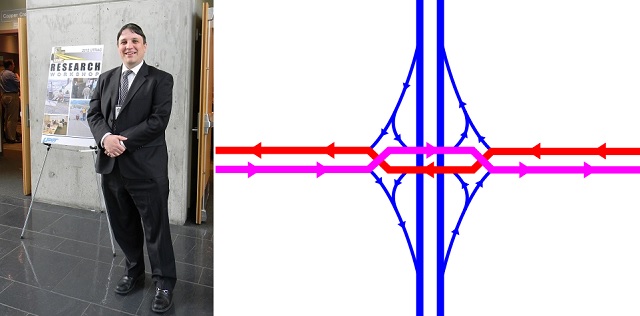
He shared the history, benefits, and application of innovative geometric design in the US and the numerous types of innovative intersections and interchanges that are springing up throughout the US. Gilbert has been assisting the Federal Highway Administration spread the word about them throughout the US and has been involved with many planning, design, and research projects on innovative designs throughout the country.
What benefit do these interchanges and intersections offer their users? Think significantly improving traffic operations and reducing crashes of all types at a fraction of the cost of conventional solutions!