2015-11-10: Impact on Traffic Mobility of V2V Communication
George Washington University (November 10, 2015): How will vehicle-to-vehicle communication impact your commute? Our speaker, Dr. Samer Hamdar, an assistant professor at the George Washington University (GWU) and the Director of the Center of Intelligent Systems Research (CISR – www.cisr.gwu.edu), provided a research-based perspective to this question.
With billions of vehicle miles traveled annually in the U.S alone, significant improvements associated with traffic mobility and safety are needed. Such improvements are represented by an increase in traffic stability and a reduction in congestion. Interactions between individual drivers and errors in the driving decision making processes have been previously identified as major contributors to unsafe and unstable traffic conditions. Two main avenues that reduce/remove human error from the driving experience are being pursued.
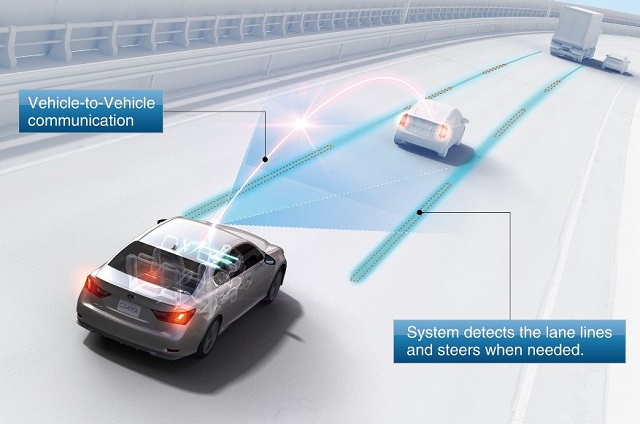
Autonomous vehicles use sensing technology to take on the burden of driving, while connected vehicles incorporate vehicle-to-vehicle and vehicle-to-infrastructure communication to obtain and share information that can allow the driver/vehicle to make better driving decisions.
After presenting existing applications of connected vehicle (CV) technologies as foreseen by the Federal Highway Administration, shared the findings of his research that models the traffic stability of different market penetration rates (MPRs) of connected and autonomous vehicles with focus on car-following and lane-changing maneuvers. The results show an increase in roadway capacity and an improvement in traffic stability as the MPR and the CV level of control increase. However, the greatest benefit comes when all vehicles on the road are autonomous with no human drivers!
2015-09-08: Risk Informed Civil Project Delivery
George Washington University (September 8, 2015): More often than not, civil infrastructure mega-projects come in over budget while the scope increases as the project moves forward. Why is that? And what can we do about it?
Michael O’Connor shared his insights that he learned in the trenches as a risk manager and direct report to first the director of Federal Transit Administration’s Office of Engineering in its Office of Program Management and then the Regional Administrator in Region II (New York City). His responsibilities included program development for technical requirements in cost and schedule modeling and contingencies; validating megaproject cost and schedules for projects with total value over $25 billion. He provided major inputs into FTA’s proposed rulemaking on risk management including concepts of management capacity and organizational capacity, risk definitions and risk mitigation classification and sequence.
2015-07-18: Railroad Picnic and Excursion
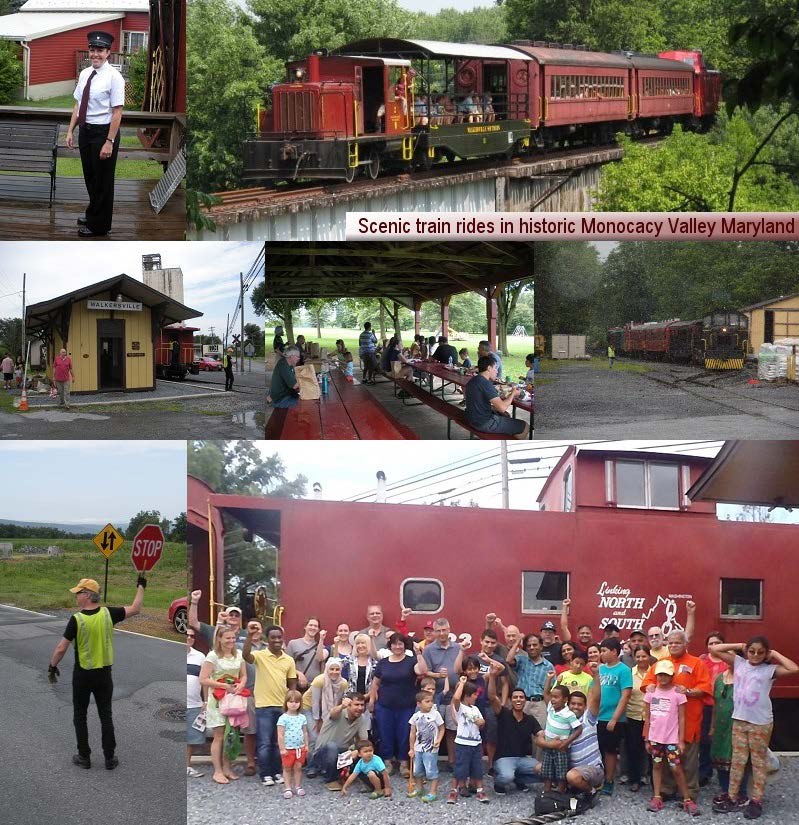
The Transportation Committee hosted its Railroad Excursion & Picnic event on Saturday, July 18, 2015, at the Walkersville Southern Railroad in Walkersville, MD. Despite the morning rain, sometimes heavy, we had a great turnout. L.J. Sauter took the photographs in the collage you see here; Ranjit Sahai took the group photo (bottom right), and the “Scenic train rides…” photo (top right) is courtesy of the Walkersville Southern Railroad.
Photographs, from the top to the bottom, left to right, are: train conductor, locomotive and cars we rode; the Walkersville Southern railroad station; the picnic shed the railroad yard; the railroad flagger at railroad-street intersections; and NCS group photo after the hour-long excursion on the historic train that was built in the 1870s.
2015-05-12: Advances in Innovative Interchanges and Intersections
George Washington University (May 12, 2015): The pace of acceleration in innovative intersection and interchange design concepts picked up significantly in the US after the publication of the paper on the Diverging Diamond Interchange in 2003 by Gilbert Chlewicki, who was the speaker for this session. The session was held at noon at the GWU campus near the Foggy Bottom metro station.
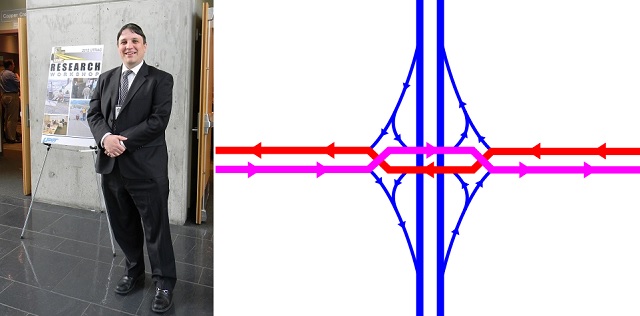
He shared the history, benefits, and application of innovative geometric design in the US and the numerous types of innovative intersections and interchanges that are springing up throughout the US. Gilbert has been assisting the Federal Highway Administration spread the word about them throughout the US and has been involved with many planning, design, and research projects on innovative designs throughout the country.
What benefit do these interchanges and intersections offer their users? Think significantly improving traffic operations and reducing crashes of all types at a fraction of the cost of conventional solutions!
Transportation Committee Event Schedule (2015-16)
The Transportation Committee meets, typically, at the George Washington University, Foggy Bottom Campus (near the "Foggy Bottom - GWU" metro station) every other month around noon. The meetings are educational opportunities held in the Lehman Auditorium (Room B1270), Science and Engineering Hall, 800 22nd Street NW, Washington DC. For training sessions, attendees receive 1 PDH.
The following table lists the 2015-16 meeting schedule and topic:
| Date | Topic | Description |
|---|---|---|
| May 12, 2015 | Understanding Innovative Highway Interchanges & Intersections (Speaker: Gilbert Chlewicki) | The pace of acceleration in innovative intersection and interchange design concepts has picked up significantly in the US since the publication of the paper on the Diverging Diamond Interchange in 2003 by Gilbert Chlewicki, who will be our speaker for this session. Discover the history, benefits, and application of innovative geometric design in the US and the numerous types of innovative intersections and interchanges that are springing up throughout the US. Gilbert has been assisting the Federal Highway Administration spread the word about them throughout the US and has been involved with many planning, design, and research projects on innovative designs throughout the country. What innovation do these interchanges and intersections leverage? Think significantly improving traffic operations and reducing crashes of all types at a fraction of the cost of conventional solutions! (Meeting Champion: Ranjit Sahai) |
| July 18, 2015 | Railroad Excursion and Picnic | The nineteenth century saw the birth of the American Railroad. Come ride a train powered by a diesel-locomotive and discover the revolution that set in motion the dynamics that have made the American people and goods so mobile in the modern era. Click here for event flyer. (Meeting Champions: Mike O'Connor and Shri Yamijala) |
| September 8, 2015 | Risk Informed Civil Project Delivery | Managing infrastructure scope and budget creep thorough risk informed project management theory and practice within the public sector is vital to helping our mega infrastructure projects come in on time and budget. (Meeting Champion: Mike O'Connor) |
| November 10, 2015 | Connected Vehicles Infrastructure | Discover what the US Department of Transportation has in the works for connecting vehicles to surface transportation infrastructure to improve driver safety over the next few years and decades. (Meeting Champion: Dr. Samer Hamdar.) |
| January 11 (Monday), 2016 | Recent Innovations in Bridge Inspection Techniques | Learn about scanning technologies for condition assessment of bare concrete decks including Ground Penetrating Radar for network level assessment and Impact Echo Scanning for detailed level assessment. Case studies with test results will be presented in which comparison/ground-truthing techniques (sounding, coring, etc.) were employed. Additionally, a monitoring technique using Interferometric Radar for remote static and dynamic monitoring of bridges will be discussed. This noncontact technology can obtain simultaneous displacement and vibration measurement of the structure. Speaker: Larry Olson of Olson Engineering. (Meeting Champion: Mike Scott) |
| March 8, 2016 | Recent Innovations in Airport Pavement Design | The majority of US airports were built during World War II with concrete runways. Since then, major advancements in pavement engineering have emerged and have been employed as these aging runways require rehabilitation or reconstruction. Discover modern airport pavement design methods, which provide increased safety, longevity, constructability and sustainability. Our speaker, Hugh Weaver, PE, is an expert on aviation pavements with over 30 years of experience at airports across the country. (Meeting Champion: Alan McDonald) |
All ASCE NCS members and interested non-members are invited to attend Transportation Committee activities.
Sincerely,
Ranjit Sahai (Chair); Shri Yamijala (Vice Chair); Mike O'Connor (Member); Samer Hamdar (Member); Mike Scott (Member); Alan McDonald (Member).