
Dr. Z’s Corner (201510) - A New Era for the PE Exams: Are You Ready for the New Specifications?
Part 5 – Structural Engineering Exams
By Ahmet Zeytinci, P.E., F-NSPE

As discussed in our previous articles, the new PE exam specifications were implemented, effective April 2015. In the March, April, June, and September issues, we discussed in detail the new specifications for the “Construction Module,” “Geotechnical Module,” “Water Resources & Environmental Module,” and “Transportation Module.” This month we will discuss the Structural Engineering (SE) exams.
PE SE Exam Specifications and Design Standards:
- According to the National Council of Examiners for Engineering and Surveying (NCEES), the SE exam tests the engineers’ ability to practice SE.
- The SE exam is designed for engineers who practice in jurisdictions that may license structural engineers separately from other professional engineers.
- This 16-hour (two-day) exam tests engineers’ ability to safely design buildings or bridges using a separate vertical and lateral component, particularly in areas of high seismicity and high wind.
- Exam specifications and design standards are posted 6 months before the exam administration. Updates to April exams are posted in November, and updates to October exams are posted in May.
- The exam uses the US Customary System (USCS) of units.
SE Exam Includes:
A two-day exam (Friday and Saturday) with separate, 8-hour components, as follows:
- Each day has a morning breadth and afternoon depth section.
- Friday covers Vertical Forces with Design Standards.
- Saturday covers Lateral Forces with Design Standards.
Note: the 8-hour Vertical Forces (Gravity and Other) and Incidental Lateral component is offered only on Friday and focuses on gravity loads and lateral earth pressures.
Lateral Forces (Wind/Earthquake) Component of the Structural Engineering DEPTH Exam Specifications:
The 4-hour Lateral Forces (Wind/Earthquake) depth examination is offered on Saturday afternoon. The SE exam depth modules focuses on a single area of practice. Examinees must choose either the Buildings or the Bridges module and must work the same module on both components. In other words, if you choose Bridges for the Vertical Forces component, then you must choose Bridges in the Lateral Forces component. All questions are constructed response (essay).
Buildings: The depth exam in the Buildings module covers lateral forces, lateral force distribution, analysis methods, general structural considerations (element design), structural systems integration (connections), and foundations and retaining structures.
This 4-hour module contains one problem from each of the following areas:
- Steel structure
- Concrete structure
- Wood and/or masonry structure
- General analysis (e.g., existing structures, secondary structures, non-building structures, and/or computer verification)
All problems are equally weighted.
At least two problems include seismic content at Seismic Design Category D and above.
At least one problem includes wind content of at least 110 mph.
Problems may include a multistory building.
Problems may include a foundation.
Bridges: The depth exam in Bridges covers gravity loads, superstructures, substructures, and lateral forces and may test pedestrian bridge and/or vehicular bridge knowledge. This 4-hour module contains three problems, one from each of the following areas:
- Columns (25% of your score)
- Footings (25% of your score)
- General analysis (i.e., seismic and/or wind) (50% of your score)
SE Design Standards*
These standards apply to the Vertical and Lateral components of the SE exam. Effective beginning with the April 2015 examinations, Revised April 20, 2015.
Abbreviation & Design Standard Title:
AASHTO, AASHTO LRFD Bridge Design Specifications, 6th edition, 2012, American Association of State Highway & Transportation Officials, Washington, DC.
IBC, International Building Code, 2012 edition (without supplements), International Code Council, Falls Church, VA.
ASCE 7, Minimum Design Loads for Buildings and Other Structures, 3rd printing, 2010, American Society of Civil Engineers, Reston, VA.
ACI 318, Building Code Requirements for Structural Concrete, 2011, American Concrete Institute, Farmington Hills, MI.
AISC, Steel Construction Manual, 14th edition, American Institute of Steel Construction, Inc., Chicago, IL.
AISC, Seismic Design Manual, 2nd edition, American Institute of Steel Construction, Inc., Chicago, IL.
AISI, North American Specification for the Design of Cold-Formed Steel Structural Members, 2007 edition with Supplement No. 2 (2010), American Iron and Steel Institute, Washington, DC.
NDS, National Design Specification for Wood Construction ASD/LRFD, 2012 edition & National Design Specification Supplement, Design Values for Wood Construction, 2012 edition, American Forest & Paper Association, Washington, DC.
NDS, Special Design Provisions for Wind and Seismic with Commentary, 2008 edition, American Forest & Paper Association, Washington, DC.
PCI, PCI Design Handbook: Precast and Prestressed Concrete, 7th edition, 2010, Precast/Prestressed Concrete Institute, Chicago, IL.
TMS 402/602, Building Code Requirements and Specifications for Masonry Structures (and related commentaries), 2011; The Masonry Society, Boulder, CO; American Concrete Institute, Detroit, MI; and Structural Engineering Institute of the American Society of Civil Engineers, Reston, VA.
Final Notes: Solutions to exam questions that reference a standard of practice are scored based on this list. Solutions based on other editions or standards will not receive credit.
Check our previous articles (September 2015) for the open-book policies.
Good Luck,
Ahmet Zeytinci, P.E., (Dr. Z.)
The NCS congratulates Dr. Z on his award and article in PE magazine. View the article now!
Dr. Z’s Corner (201511) - Three Es & Statistics: Journey to Become a P.E.
Three Es & Statistics: Journey to Become a P.E.
By Ahmet Zeytinci, P.E., F-NSPE
Quite often engineering students ask us why engineering graduates with engineering degrees need licensure to practice. The answer is quite simple: to protect the public health, safety, and welfare. To ensure the protection, the practice of engineering has been entrusted by various governmental entities only to those persons duly licensed and registered. To become a licensed Professional Engineer, commonly called the three Es: approved Education, appropriate Experience, and Examination is required.
For the last five articles of Dr. Z’s Corner, we focused on the PE exams to answer some of our readers’ questions – mostly senior engineering stu-dents. This month, we will talk about the Fundamentals of Engineering (FE) Exams and provide some basic facts and statistics.
- The FE exams are designed for recent graduates and students who are close to completing an undergraduate degree in engineering.
- Passing the FE exam is an important first step in the engineering licensure process.
- The National Council of Examiners for Engineering and Surveying (NCEES) administers the FE exam throughout the year, during the months of January, February, April, May, July, August, October, and November.
- NCEES policy allows an examinee to take the FE exam once during a two-month window, and no more than three times during a twelve-month period.
- NCEES is a national nonprofit organization composed of engineering and surveying licensing boards representing all 50 states, the District of Columbia, Guam, Puerto Rico, and the U.S. Virgin Islands.
Many schools realize that engineering positions at all levels of industry and government increasingly require licensure and because of that, they promote the benefits of licensure to their students and encourage their students to take the FE exam.
According to the American Society for Engineering Education:
- The total number of engineering bachelor’s degrees awarded in 2013 was 93,360, and among those, the total number of FE exam takers was about 50%, or about 45,362.
- The pass rate of all first-time FE exam takers was about 70%.
- The total number of the first time takers with EAC/ABET Bachelor’s Civil Engineering degrees in the same year was about 9,650, with the pass rate of 72%.
- There were 3,180 repeat takers, with a pass rate of 31%.
- The average age of FE exam takers was about 27.5 in 2010, while in 2014 the average age of the FE exam takers dropped to 25.
The FE exam fee is about $225. It consists of 110 questions, and you have 5 hours and 20 minutes to complete the entire exam. The latest version of the appropriate NCEES Reference Handbook (Currently version 9.3, Computer Based Test) will be supplied onscreen as a searchable PDF. All NCEES examinees will use a 24-inch monitor while testing to allow sufficient space to display both the exam question and the reference handbook.
Those preparing for the FE exam are strongly advised to use a self-study approach and review subject areas with which you are familiar or you know best. This will give you more time and build your confidence. For many students, reviewing the problems given in the NCS archives for “Dr. Z’s Corner” monthly articles was very helpful (available on our website).
As we always remind our readers, FE is a very fast-paced exam and you will have little time to look up information. Knowing the locations of the various formulas in the FE Reference Handbook is a crucial time saver. Also, remember to consider reverse engineering the problems by substituting the answers and seeing which one works. To help prepare for the exam, Click Here for this month’s problem set.
As we always advise, stay relaxed and confident. Keep a good attitude and remind yourself that you are going to do your best!
Until next time,
Ahmet Zeytinci, P.E., (Dr. Z.)
Editor’s note: All of the past problem sets are available on our website.
Dr. Z’s Corner (201601) - ASCE-2016 Centennial Celebration: Dr. Z’s Corner & Exciting New Features
By Ahmet Zeytinci, P.E., F-NSPE
Our readers may know by now the “Outstanding Website Award” winner, the NCS is celebrating its 100th year in 2016. Accordingly, all activities, including our column, will have a centennial focus this year. You may have already noticed the new look and user-friendly functionality of the new Dr. Z’s Corner. This major overhaul was the result of a great teamwork of many individuals at the NCS, the Board members, Scott, Chris, Ranjit, Rachel, L.J., and my good friend Prof. Dr. Vagelis Plevris from Greece. I would like to thank each of you for your dedication to the profession and commitment to engineering students and practicing engineers not only in the Washington metro area but also in the nation and around the globe.
Now with the new features of Dr. Z’s Corner, our readers will have easy access to all timeless articles, past issues, hundreds of original problems, solutions, tips, and applications with a click of a mouse. Once www.asce-ncs.org is entered, the readers will see the NCS’s beautiful centennial logo on the top left of the menu bar and “Special Features” on the right. As soon the cursor is placed on the “Special Features,” Dr. Z’s Corner will welcome them in no time with its debut issue published in June 2014.
This holiday season, as we reflect on 2015, I would also like to congratulate the students from all engineering schools in the metro area. This includes UDC, Howard, UM-College Park, George Mason, Catholic, Morgan State, Virginia Tech, and Villanova, who read our column, downloaded hundreds of problems from this site for free, tirelessly attended our pro-bono Saturday classes and finally “conquered” the FE and PE exams. We have to add; some of our readers were not as fortunate and could not make it on their first attempts. Still, they have graciously sent us thank-you notes as well. I will never forget the note that I received from an engineering student from CUA who not only diligently attended to our Saturday classes, but also brought several students with her from her school week after week. She wrote:
Dear Dr. Z,
I hope all is well with you. With finals approaching and the semester almost over, I won’t be able to stop by your Saturday classes before the year ends. Although I did not receive your email, my friend told me that you have sent us an email asking about the FE exam results. Unfortunately, I was not able to pass the FE exam… I apologize Dr. Z., for letting you down! I know that you had faith that I will pass…. However, my goal is still to pass the exam before I graduate this coming May, so I’m planning on retaking the exam probably on February. I will be working on the problems on Dr. Z’s Corner during the holiday break. Despite failing, I would want to thank you for all your help in our preparation for the exam. I also look forward in going to your Saturday Classes, if you still have them early next year. Sincerely
I want this outstanding engineering student to know that she did not let Dr. Z. down at all. Just the contrary, considering her full-time work to support herself and pay her bills, her course work to finish and the finals, she did remarkably well on her first try. I am confident; we will support her and she will pass her exam in February. Our promise has always been “we’ll never rest our case, until all our students who read Dr.Z’s Corner and attend our pro-bono Saturday sessions conquer their FE & PE exams.” For this month’s problems click here.
Finally, I want to wish each of you a joyous holiday season with peace & cheer in the New Year!
Until next time,
Ahmet Zeytinci, P.E., (Dr. Z.)
Dr. Z’s Corner (201602) - A Picture is Worth a Thousand Words: Demystifying the Shear Force and Bending Moment Diagrams
By Ahmet Zeytinci, P.E., F-NSPE
It is no secret that I received all my degrees from Istanbul Technical University (ITU), founded in 1773. ITU is one of the premier engineering schools in Europe, and back in the early 1970s, we had about 150 full-time faculty members and support staff in our Civil Engineering department. For my doctoral research, I was working on a highly mathematical problem on vibrations of plates and one of my Ph.D. advisors was a professor who worked with the well-known scientist Richard Edler von Mises at Harvard University while completing his PhD. Some of my readers may also remember von Mises who defined the yield criterion that suggests that the yielding of materials begins when the second deviatoric stress invariant J2 reaches a critical value. As I reflect on my 40-year career in structural engineering, it is remarkable to see how the landscape has changed, while some knowledge and educational tools that I learned from my mentors are priceless and I use them in my classes every day. Today we will focus on shear force (V) and bending moment (M) diagrams. Many students struggle when they try to draw their first shear and moment diagrams.
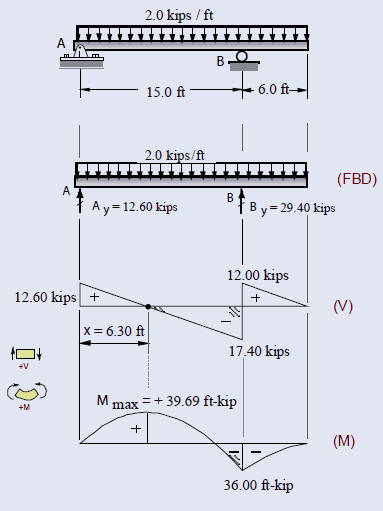
In structural engineering, we are interested in the analysis and design of beams or structural members supporting concentrated and/or distributed loads that are mostly perpendicular to the axis of the members. In practice, beams are usually long, straight, and prismatic and such transverse loadings would cause only bending and shear forces. When the loads are not perpendicular to the member, they also produce axial forces as well. The concentrated loads may be expressed in newtons (N), pounds (lb), or their multiples, kilonewtons (kN) or kips. Distributed loads are generally expressed in N/m, kN/m, lb/ft or kips/ft. A shear force diagram (V) is a graph in which the abscissa (horizontal reference axis) represents distances along the beam length, and the ordinates (vertical measurements) represent the transverse shear at the corresponding beam section. A moment diagram (M) is a graph in which the abscissa represents distances along the beam and the ordinates represent the bending moment at the corresponding sections. Shear and moment diagrams can be drawn by calculating values of shear and moment at various sections along the beam and plotting enough points to obtain a smooth curve. Such a procedure is rather impractical and time consuming.
Right at this point, I remember my Ph.D. advisor’s words, “A well-drawn (V) and (M) diagram is like ‘poetry’ for some of us and you have to feel them without doing any number crunching.” My colleague Vagelis did just that for our readers and prepared a dozen beautiful diagrams using his well-known software, Beam-2D as shown in the Problem Section this month.
For the sign conventions, positive moment generates a curvature that tends to hold water (concave-upward curvature) or moment creating tension in bottom fibers of beam, whereas negative moment causes curvature that sheds water (concave-downward curvature). For the sign of shear, positive shear is the upward shear to left. This is a standardized and universally accepted convention. Because the convention is related to the probable deflected shape of the beam for a prescribed loading condition, it may be helpful to intuitively sketch the beam’s deflected shape to help in determining the appropriate signs. With the aid of such diagrams, the magnitudes and locations of various important quantities like Mmax become immediately apparent. The maximum moment Mmax occurs at places where shear = 0 or V changes sign. It is convenient to draw these diagrams directly below the free-body diagram of the beam using the same horizontal scale. Why these diagrams are so important? Because by using these diagrams, an engineer can see, at a glance, the performance requirements of a structural member at every section.
Finally, we have to remind our readers that FE and PE are very fast-paced exams and you will have little time to look up information. Therefore, make sure you are familiar with your reference material and begin with the subject areas you know best. This will give you more time and build your confidence.
Most importantly, stay relaxed and confident. Always keep a good attitude and remind yourself that you are going to do your best!
Until next time,
Ahmet Zeytinci, P.E.
Dr. Z’s Corner (201603) - You Finally Are Ready To Take the Exam: Now What Do You Do?
To answer many of our new readers’ questions, today we would like to review all the basics for the first time FE exam takers and tell you step-by-step what to do before the exam and during the exam day morning.
As you may know, The National Council of Examiners for Engineering and Surveying (NCEES) develops and scores the FE, PE, and SE exams for engineering licensure. The FE Exam is the first step in the arduous process leading to obtaining a Professional Engineering (PE) license and it is designed for recent graduates and students who are close to finishing their undergraduate degrees.
How do you register for the FE exam?
If you are ready to take the FE exam first time, do the following to register:
- Visit the NCEES website at www.ncees.org
- Click on the exam tab in the menu,
- Select your state or foreign entity from the drop-down list,
- Follow all the instructions to get approval to sit for the exam,
- Create an account with NCEES and register before the deadline,
- Pay the exam fee required in your state or territory,
Once you complete all the above, then wait for the confirmation email.
What do you do on the morning of the exam?
Once your registration is approved, you will receive an email notification that you have been authorized to take the exam and are eligible to schedule your exam appointment. FE tests are computer based tests and offered in testing windows throughout the year during January, February, April, May, July, August, October and November.
When approaching the FE Exam for the first time, it is natural to feel a bit overwhelmed. The best way to build your confidence is to prepare for the test (visit this month’s problem set) and to know the ins and outs of the test.
Once you register and know your exam date, we suggest you arrive at the testing center 30 minutes prior to your scheduled appointment. Upon arrival:
- A representative will provide you with a copy of NCEES-CBT (Computer Based Test) rules for your review.
- After reviewing, provide your digital signature to confirm that you have read the rules and agreed to abide by them.
- You will need to provide a current government issued identification (such as a driver’s license).
- Once the representative confirmed your identification and the exam that you are taking, you will be asked to provide palm vein scan and have your photo taken.
Prior to being admitted into the testing room, a representative will confirm that the only NCEES-allowed items with you in the testing room. These include your ID, an NCEES-approved calculator and eyeglasses. Most test centers have secure storage lockers on site for you to store prohibited items such as cell phones, other electronic devices, and personal belongings (e.g., wallet and bag).
Once you complete the check in process, report to an exam proctor who will confirm your ID through a palm vein scan. The proctor will then provide with you with a reusable booklet and marker for scratch work, review the exam rules, and escort you to the exam room and assigned workstation, and launch the exam.
Before starting your exam, all examinees are required to read and agree to the NCEES’ non-disclosure agreement and complete a brief tutorial to learn how to ADVANCE to the next item, RETURN to a previous item and FLAG items for review.
After completing approximately 55 questions, examinees will be prompted on screen with the option to take a 25-minute break. Examinees who wish to take the scheduled break should raise their hands and wait for the prompter tor assistance. Unscheduled breaks may be requested at any time during the exam by following the same procedure. However, be aware that the clock will not stop during an unscheduled break.
After completing the exam and a brief survey, you should raise your hands and proctor will verify that you had properly exited from exam, escort you from testing room, and collect your booklet and marker. You will receive an email from NCEES within 7 to 10 days notifying you that your results are available for viewing in your MYNCEES account.
Remember during the FE exam, timing is everything and that is why you must have a game plan and a wristwatch. All the best!
Until next time,
Ahmet Zeytinci, PE
Dr. Z is our March 2016 NCS Centennial Engineer of the Month! Read his interview in the newsletter.
- Dr. Z’s Corner (201604) - Let's Talk about Engineering Ethics: NCEES Rules of Professional Conduct - Part I
- Dr. Z’s Corner (201605) - Let’s Talk about Engineering Ethics: NCEES Rules of Professional Conduct – Part-II
- Dr. Z’s Corner (201609) - Time Really Flies – Especially When You Are Having Fun
- Dr. Z’s Corner (201610) - Why Do You Need a PE License?