Dr. Z’s Corner (201709) - Please Welcome Our New Contributors: Dr. Bryan Higgs & Dr. Lei Wang

I am very excited to welcome our readers to the beginning of a new school year. Quite often we get emails from our readers, students, educators and engineers about Dr. Z’s Corner and learn what they think about our articles and problems. We are pleased to report that our readers are benefitting from our work and it feels great to make a difference.
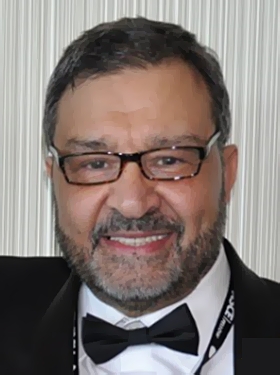
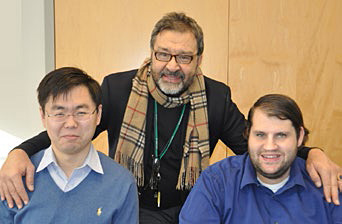
(Photo: From Left: Dr Lei Wang, Dr Z, Dr Bryan Higgs)
I would also like to remind our readers that Dr. Z’s Corner is a public service and everything we do is pro-bono! We are proud to be part of ASCE-NCS and to provide free help to the engineering community not only in the Washington metro area, but also around the nation and the globe.
Again I would like to take this opportunity to thank my great editor James Palmer, President Jordan Pitt and board of directors of the ASCE-NCS for their dedication to the engineering community. We appreciate all their hard work.
For us, September 1st is a new start with the opportunity to focus, refresh, and rethink the priorities and work hard to get ready for licensure. And remember, standards matter, character counts, and now more than ever, your PE can be the competitive edge you need.
Let me remind our readers one more time: to conquer the FE and PE exams, you definitely need good time management skills that can make all the difference in keeping track and staying on top of things. You may be ambitious, but being realistic will definitely help you achieve your goals and allow you to be not only successful but also happy, and less stressed out about your achievements.
I consider myself very fortunate to have great team members that are extremely passionate, enthusiastic, and very knowledgeable in their areas of expertise.
For the last three years, my colleague and good friend Dr Vagelis Plevris from Oslo, Norway, has been tirelessly helping me on everything, including preparing and solving problems using his software BEAM-2D. And now are we ready for the big announcement: I’m delighted to announce that effective September 2017; Dr. Z’s Corner will have two new world-class engineers and contributors joining our team and helping us in the Transportation and Geotechnical areas. Please join me to welcome Dr. Lei Wang from Clemson University and Dr. Bryan Higgs from Virginia Tech. Currently both of them are full-time faculty members at UDC Civil Engineering Department. Please review their problems and here are their brief bios:
Dr Bryan Higgs
Dr Bryan Higgs recently moved to Washington, DC area to join UDC. All his degrees are from Virginia Tech, including his PhD in Transportation Engineering. Prior to this position, he was an Intelligence Community Postdoctoral Research Fellow at the University of Memphis.
Bryan’s research and teaching interests range from network design to human factors in transportation including: multi-level multi-objective game theory, network vulnerability, network optimization, psychophysiological driver behavior, driving simulators, road rage, aggressive driving behavior, and traffic flow theory.
Dr. Higgs has published in top-tier journals, and is a member of several national professional organizations. In addition to his national and international service, he enjoys participating in outreach activities for fostering interest in transportation in middle and high school students.
Please read Dr. Higg’s “Career Highlights” and solve his transportation problems in this month’s Dr. Z’s Corner, problems section (Editor’s Note: All Dr Z’s Corner Problem sets are available on the ASCE-NCS Website: Dr Z’s Corner).
Dr Lei Wang, PE
Dr Wang has recently moved to Washington, DC area to join UDC. He received his PhD degree in Civil Engineering with a geotechnical emphasis from Clemson University in 2013. His BS degree is also in Civil Engineering from China University of Geosciences conferred in 2008 and his MS degree in Geotechnical Engineering from Tongji University completed in 2010. Prior to his current position, he worked as a Post-Doctoral Fellow at Clemson University as a Geotechnical Engineer at Geotechnical and Tunneling Technical Excellence Center of WSP/ Parsons Brinckerhoff and as an Assistant Professor of Civil Engineering at Montana Tech of the University of Montana.
Dr Wang has an extensive research and practical experience in geotechnical engineering, including underground excavation and tunneling, soil/rockstructure interaction, numerical and centrifuge modeling, earth dams and levees, foundation engineering, and geotechnical earthquake engineering. He has published over 40 refereed journal and conference papers with a Google Scholar Citation of over 400. He was a recipient of many honors and awards, including the Best Paper Award by Taiwan Geotechnical Society (2013) and the Outstanding Graduate Researcher Award at Clemson University (2013). He is a Professional Engineer registered in California.
Finally we have to remind our readers that FE and PE are very fast-paced exams and you will have little time to look up information. Therefore, make sure you are familiar with your reference material and begin with the subject areas you know best. This will give you more time and build your confidence.
And most importantly, stay relaxed and confident. Always keep a good attitude and remind yourself that you are going to do your best!
Until next time,
Ahmet Zeytinci, P.E.
Dr. Z. (
Dr. Z’s Corner (201710) - Only one thing is better than being an engineer: being a Professional Engineer (PE)
Every month Dr Z’s Corner receives many questions from students and engineers about the Fundamentals of Engineering (FE) and Professional Engineer (PE) exams and this month we would like to give a brief overview of these exams, including some new test formats.
Clean water, sound structures and safe power. Professional Engineers are charged with preserving these and many more fundamentals that protect the health, safety, and welfare of the public. In other words Professional Engineers help make us healthier, keep us safer and allow all of us to live better lives than ever before. Earning your license and joining the community of professionals committed to excellence will definitely change your life! And the first step in this journey is to take the FE exam. The National Council of Examiners for Engineering and Surveying (NCEES) develops and scores all the FE, PE, and SE exams for engineering licensure in the United States.
Fundamentals of Engineering (F.E.) Exam
The Fundamentals of Engineering (FE) exam is generally your first step in the process to becoming a professional licensed engineer (PE). It is designed for recent graduates and students (seniors) who are close to finishing an undergraduate engineering degree from an EAC/ABET – accredited program. The FE exam is a computerbased
test (CBT) administered yearround at NCEES-approved Pearson VUE test centers.
The FE exam is closed book with an electronic reference and includes 110-questions. The exam appointment time is 6 hours long and includes: Nondisclosure agreement (2 minutes), tutorial (8 minutes), and actual exam a 25-minute scheduled break. For FE exams, the most current version of the appropriate NCEES-supplied reference handbook (v.9.4) will be supplied onscreen as a searchable PDF. All NCEES examinees will use a 24-inch monitor while testing to allow sufficient space to display both the exam questions and the reference handbook.
FE Exam Disciplines
The FE is offered in seven disciplines as follows: FE Chemical, FE Civil, FE Electrical and Computer, FE Environmental, FE Industrial and Systems, FE Mechanical and FE Other Disciplines.
Starting July 1, 2017, the computerbased FE introduces a new testing component called Alternative Item Types (AITs). AITs are questions other than traditional multiple-choice questions. The exam fee is $225 and payable directly to NCEES.
Registering for the exam is quite simple: You can register for the FE exam by logging in to your MyNCEES account and follow the onscreen directions.
Professional Engineering (PE) Exam
The PE license is the highest standard of professionalism in engineering.
The PE exam is designed to test for a minimum level of competency in a particular engineering discipline. It is designed for engineers who have gained a minimum of four years of work experience in their chosen engineering discipline. The SE exam is designed for engineers who practice in jurisdictions that license structural engineers separately from other professional engineers.
In order to become a Professional Engineer and earn a PE seal engineers must complete the following steps: Earn a four-year degree in engineering from an EAC/ABET accredited engineering program, pass the Fundamentals of Engineering (FE) exam, complete four years of progressive engineering experience under a PE, and pass the Principles and Practice of Engineering (PE) exam. The PE Exam is also created and scored by the National Council of Examiners for Engineering and Surveying (NCEES).
PE Civil Engineering Exam
The Principles and Practice of Engineering (PE) exam tests for a minimum level of competency in a particular engineering discipline. It is designed for engineers who have gained a minimum of four years’ post-college work experience in their chosen engineering discipline.
The PE Civil exam is an 8-hour exam with 80 questions. It is administered in pencil-and-paper format twice per year in April and October. See all of Dr Z’s Practice Problem Sets, including October’s, here!
The PE Civil exam is a breadth and depth examination. This means that examinees work the breadth section in the morning and one of the five depth modules in the afternoon. The breadth section contains questions from all five areas of civil engineering such as Construction, Geotechnical, Structural, Transportation and Water Resources & Environmental. The depth section focuses more closely on a single area of practice.
Finally, we have to remind our readers that FE and PE are very fast-paced exams and you will have little time to look up information. Therefore, make sure you are familiar with your reference material and begin with the subject areas you know best. This will give you more time and build your confidence. Also, stay relaxed and confident. Always keep a good attitude and remind yourself that you are going to do your best!
Until next time,
Ahmet Zeytinci, P.E.
Dr. Z’s Corner (201711) - A New Record: Columbia University Gives Five Scholarships to One University in the Washington Metro Area
When I remember the 1994 Tom Hanks movie Forrest Gump, I always smile. In the movie Tom Hanks said “My mom always said life is like a box of chocolates. You never know what you’re gonna get.” I think this is very true in academia as well. I’ve been in academia for more than 40 years and have worked as a project engineer, researcher and professor in Europe and Japan before moving to Washington, DC. Throughout my career, I’ve consider myself to be a very fortunate college professor since I have been honored by numerous local, regional and national awards from various engineering organizations and universities, including my own institution.
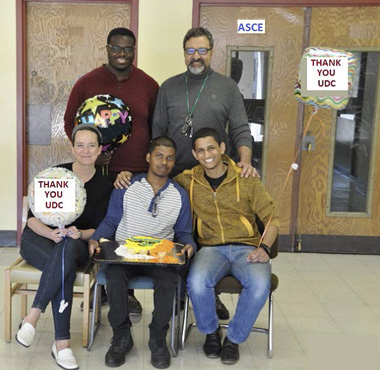
(Photo: Scholarship Winners from Columbia University: All of them are Civil Engineering students from UDC. Standing from left: Kwame Baah and Dr. Z. Seated from left: Patricia Wolfbauer, Suraj Narain and Brahim Sidi M’Hamed. Not shown: Andrew Asiimwe)
While these honors and accolades are meaningful, nothing gives me more joy than seeing my students achieve significant milestones in their preparation and careers. And today, I’ve decided to write about some of our students; who they are, what they do and why they are so unique?
Is it possible to inspire, motivate, and transform a sanitary worker from Washington, DC to ultimately become a structural engineer designing the Boeing 787 Dreamliner? Hard to believe, but this was a true story. As many of our readers know, I have been offering pro-bono Saturday classes at UDC that are open to all engineering students and practicing engineers from the DC metro area who may be preparing for their FE and PE exams. These highly-intensive, informal sessions, some call “Boot Camp,” present a two-way opportunity to learn from the students about their professional goals, dreams, aspirations and sometimes even their daily struggles and challenges and help them academically and prepare them to be successful and productive engineers and citizens. Editor’s note: find all of Dr Z’s practice problem sets, including this month’s, here.
About two years ago an engineering student from my Saturday class told me, “Dr Z, I would not hesitate to tell you that when I’m not at school, I work at a small restaurant on Georgia Avenue. I’m working there as a dishwasher and making minimum wages. It may sound strange to tell others what I do for living, but I am proud. I work very hard to help my family. My father is not working and my mother is sick; therefore I have to work to help them. Washing dishes helps me to go to school, get my education, and take care of my family.” And another said that to support myself and pay my tuition, I have to deliver pizza until 4 a.m. Every day I sleep for a few hours and then come to school and study. For us, these are amazing stories of dedication, values, priorities, and grit.
And the great news is, two months ago we were thrilled to learn that five UDC students, four of them Civil Engineering Students, all from Dr. Z’s Saturday classes, have received full scholarships, including tuition and housing, to pursue their graduate studies at Columbia University. This great honor is a testament not only to their extraordinary academic and co-curricular achievements but also to the quality of the engineering education that students receive at the University of the District of Columbia. By the way, the student working at a restaurant and the otehr delivering pizza until early in the morning were of course among those that received prestigious scholarships from Columbia University.
That reminded me my brief remarks during a national award ceremony back in July 2015 in Seattle. At the podium, speaking to educators and engineers from all over the country and also executives from Microsoft and Boeing:
“UDC is a small university in the nation’s capital. This prestigious award is truly a testament that while we often take a different approach, when it comes to inspiring, motivating and most importantly, educating students – our future engineers – The University of the District of Columbia is unquestionably one of the best in the nation. While our program may be small, it is mighty! It is a transformative opportunity to change lives, broaden the field, and help engineering students achieve their dreams.”
Until next time,
Ahmet Zeytinci, P.E.
Dr. Z’s Corner (201801) - New Specifications (2018) for Structural Engineering (SE) Exams, Part-1
We wish all our readers a happy and prosperous new year. This month we would like to talk about some significant changes that will take place in the SE exams in 2018. The National Council of Examiners for Engineering and Surveying (NCEES) will be using new specifications for the Structural Engineering (SE) exams next year. Effective beginning with the April 2018 examinations the NCEES Structural-I and Structural-II exams will be administered as a single 16-hour exam given in two days.
Unlike the computer-based Fundamentals of Engineering (FE) exam, the Structural Engineering (SE) exam is still administered in a pencil-and-paper format and is an open-book test.
The SE exam consists of two modules BREADTH and DEPTH and is offered in two 8-hour components on two successive days. It includes integrated design, analysis and detailing questions. No single component of the exam is a sufficient stand-alone exam for any purpose. We recommend our readers to see the NCEES website for exact specifications.
The 8-hour Vertical Forces (Gravity/Other) and Incidental Lateral component is offered only on a Friday. It focuses on gravity loads and lateral earth pressures. The 8-hour Lateral Forces (Wind/Earthquake) component is offered only on a Saturday and it focuses on wind and earthquake loads.
The 16-hour SE exam uses separate vertical and lateral components to test the applicant’s ability to safely design buildings or bridges, especially in areas of high seismicity and high wind. It is important to remember that the exam uses the US Customary System (USCS) of units only.
The breadth modules are in the morning sessions. These modules contain questions covering a comprehensive range of structural engineering topics and all questions in the morning are multiple-choice. The depth modules are in the afternoon sessions. These modules focus on a single area of practice in structural engineering. The examinee will choose either buildings or bridges, but must work the same topic area on both components. All questions in the afternoon depth modules are essay-type problems, constructed response (essay).
The examinee is required to obtain acceptable results on both 8-hour components of the SE exam in a single exam administration. It is acceptable to sit for and obtain acceptable results on one component, and then sit for and obtain acceptable results on the second component at a later date. The examinee must obtain acceptable results on both 8-hour components within a five-year period in order to pass the Structural Engineering exam.
New Structural Engineering BREADTH Exam Specifications
The 4-hour Vertical Forces (Gravity/Other) and Incidental Lateral breadth examination is offered on Friday morning and focuses on gravity loads. It contains 40 multiple-choice questions. The exam uses the US Customary System (USCS) of units. The breadth exam is developed with questions that will require a variety of approaches and methodologies, including design, analysis, and application. The knowledge areas specified as examples of kinds of knowledge are not exclusive or exhaustive categories. Score results are combined with depth exam results for final score of this component.
Topics and approximate number of questions of BREADTH exams
Analysis of Structures
Design and Details of Structures
1 – Analysis of Structures part has a total of 13 multiple-choice questions and consists of two categories. The first category is Generation of Loads with total 5 questions. Topics include: dead loads, live loads, moving loads, impact loads, vessel collision, earth pressure, differential settlement, hydrostatic and hydrodynamic loads, flood, snow, rain, ice, thermal, shrinkage and load combinations.
2 – Load Distribution and Analysis Methods with a total of 8 questions. Topics include: static (e.g., determinate and indeterminate, location of forces and moments, free-body diagrams), shear and moment diagrams, code coefficients and tables, truss analysis methods, approximate beam or truss analysis methods and approximate frame analysis methods.
The Design and Details of Structures section has a total of 27 questions and includes the following five categories:
A-) General Structural Considerations, 3 questions
B-) Structural Systems Integration, 2 questions
C-) Structural Steel, 5 questions
D-) Cold-Formed Steel, 1 question
E-) Concrete, 5 questions
F-) Wood, 4 questions
G-) Masonry, 3 questions
H-) Foundations and Retaining Structures, 4 questions
For detailed topics in each category, our readers should consult with www.NCEES.org. But to give an idea about the topics covered in structural steel for example, the subject-list includes: tension members, columns and compression members, trusses, flexural members, plate girders, secondary support systems, shear in steel members, combined axial and flexural members, composite design, bolted and welded connections, base and bearing plates, thermal effects and bridge piers. You can find Dr Z’s practice problems for this month here.
In our February article we will talk about the Design Standards and Structural Engineering DEPTH Exam Specifications.
And finally stay relaxed and confident. Always keep a good attitude, focus on the ultimate goal and remind yourself that you are going to do your best!
Until next time,
Ahmet Zeytinci, P.E.
Dr. Z’s Corner (201802) - New Specifications (2018) for Structural Engineering (SE) Exams, Part-2
Structural Engineering Exams Are Administered Over Two Days
Last month we started discussing the new specifications for Structural Engineering (SE) Exams. The National Council of Examiners for Engineering and Surveying (NCEES) will be using new specifications for the Structural Engineering (SE) exams effective beginning with the April 2018 examinations. Registration for the pencil-and-paper April 2018 SE exams is currently open and will close at 3:00 p.m. EST on February 15, 2018. It is important to remind our readers that the registration for the computer-based FE and PE exams is open year-round and for details our readers should always consult with the NCEES website.
The new NCEES Structural Engineering exams will be administered as a single 16-hour exam given in two successive days (Friday and Saturday). The 8-hour exam on Friday focuses on vertical forces – gravity loads and lateral earth pressures. Both Friday and Saturday exams consist of breadth (morning) and depth (afternoon) modules. The 8-hour exam on lateral forces is offered only on Saturday and focuses on wind & earthquake loads. In summary:
Friday morning breadth exam: Vertical Forces (4-hour and 40 multiple choice questions. The exam uses the US Customary System (USCS) of units)
Friday afternoon depth exam: Vertical Forces (4-hour, examinees must choose either the BUILDINGS or the BRIDGES module. Examinees must work the same module on both components. Depth exam is not multiple choice; questions are constructed response, essay-type questions. The exam uses the US Customary System of units only).
Saturday morning breadth exam: Lateral Forces, Wind & Earthquake (4-hour and 40 multiple choice questions. The exam uses the US Customary System of units).
Saturday afternoon depth exam: Lateral Forces, Wind & Earthquake (4-hour, examinees must choose either the BUILDINGS or the BRIDGES module. Examinees must work the same module on both components. Depth exam is not multiple choice; questions are constructed response, essay type questions and the exam uses the US Customary System of units only).
In a nutshell, the new SE exam tests engineer’s ability to safely design buildings or bridges, particularly in areas of high seismicity and high wind.
Now let’s discuss the topics and number of questions for Friday and Saturday exams in detail:
Friday Morning Breadth Exam Specifications: Vertical Forces (Gravity/Other) and Incidental Lateral Component. Topics and Number of Questions:
Friday morning breadth exam has total 40 multiple choice problems in which 13 questions are from Analysis of Structures and 27 questions from Design and Detail of Structures. As always, find Dr Z’s practice problems here.
Friday Afternoon Depth Exam Specifications: Vertical Forces (Gravity/Other) and Incidental Lateral Component. Either BUILDINGS or BRIDGES
The BUILDING module covers loads, lateral earth pressures, analysis methods, general structural considerations (element design), structural systems integration (connections), and foundations and retaining structures. This 4-hour module contains one problem from each of the following areas: Steel Structures, Concrete Structures, Wood Structures and Masonry structures. All problems are equally weighted. At least one problem includes a multistory building, and at least one problem includes a foundation.
The BRIDGES module covers gravity loads, superstructures, substructures, and lateral loads other than wind and seismic. This 4-hour module contains three problems, one from each of the following areas: Concrete superstructure (25% of your score), other elements of bridges (e.g., culverts, abutments, retaining walls) (25% of your score), steel superstructure (50% of your score).
Saturday Morning Breadth Exam Specifications: Lateral Forces (Wind/Earthquake): Topics and Number of Questions
Saturday morning breadth exam has total 40 multiple choice problems in which 15 questions are from Analysis of Structures and 25 questions from Design and Detail of Structures areas.
Saturday Afternoon Depth Exam Specifications: Lateral Forces (Wind/Earthquake): Either BUILDINGS or BRIDGES
The BUILDING module covers lateral forces, lateral force distribution, analysis methods, general structural considerations (element design), structural systems integration (connections), and foundations and retaining structures. This 4-hour module contains one problem from each of the following areas: Steel Structures, Concrete Structures, Wood and/or Masonry Structure and General Analysis (e.g., existing structures, secondary structures, nonbuilding structures, and/or computer verification). In this section, all problems are equally weighted.
The BRIDGES module covers lateral forces, lateral force distribution, analysis methods, general structural considerations (element design), structural systems integration (connections), and foundations and retaining structures. For details the readers should see the NCEES website.
And finally, an important reminder. PE/SE is an open-book exam and make sure to bring the books to the exam that you are intimate with. You do not want to be fumbling through a strange book during the exam. Stay relaxed and confident and always keep a good attitude. Focus on the ultimate goal and remind yourself that you are going to do your best!
Until next time,
Ahmet Zeytinci, P.E.
- Dr. Z’s Corner (201803) - Discover Engineering Family Day & Advice to College Students
- Dr. Z’s Corner (201804) - ASCE Steel Bridge Competition 2018
- Dr. Z’s Corner (201805) - Approaching the FE Exam for the First Time
- Dr. Z’s Corner (201809) - Update on Dr. Z’s PRO-BONO FE/PE Review Classes for Students and Engineers from the Washington Metro Area